
Operations Notes
Why is playing YouTube Premium music in a store risky?
Personal music subscriptions are not store background-music licenses. We review YouTube Premium, Apple Music, Spotify terms, public performance rights, and why JEMPO focuses on store-ready royalty-free music.

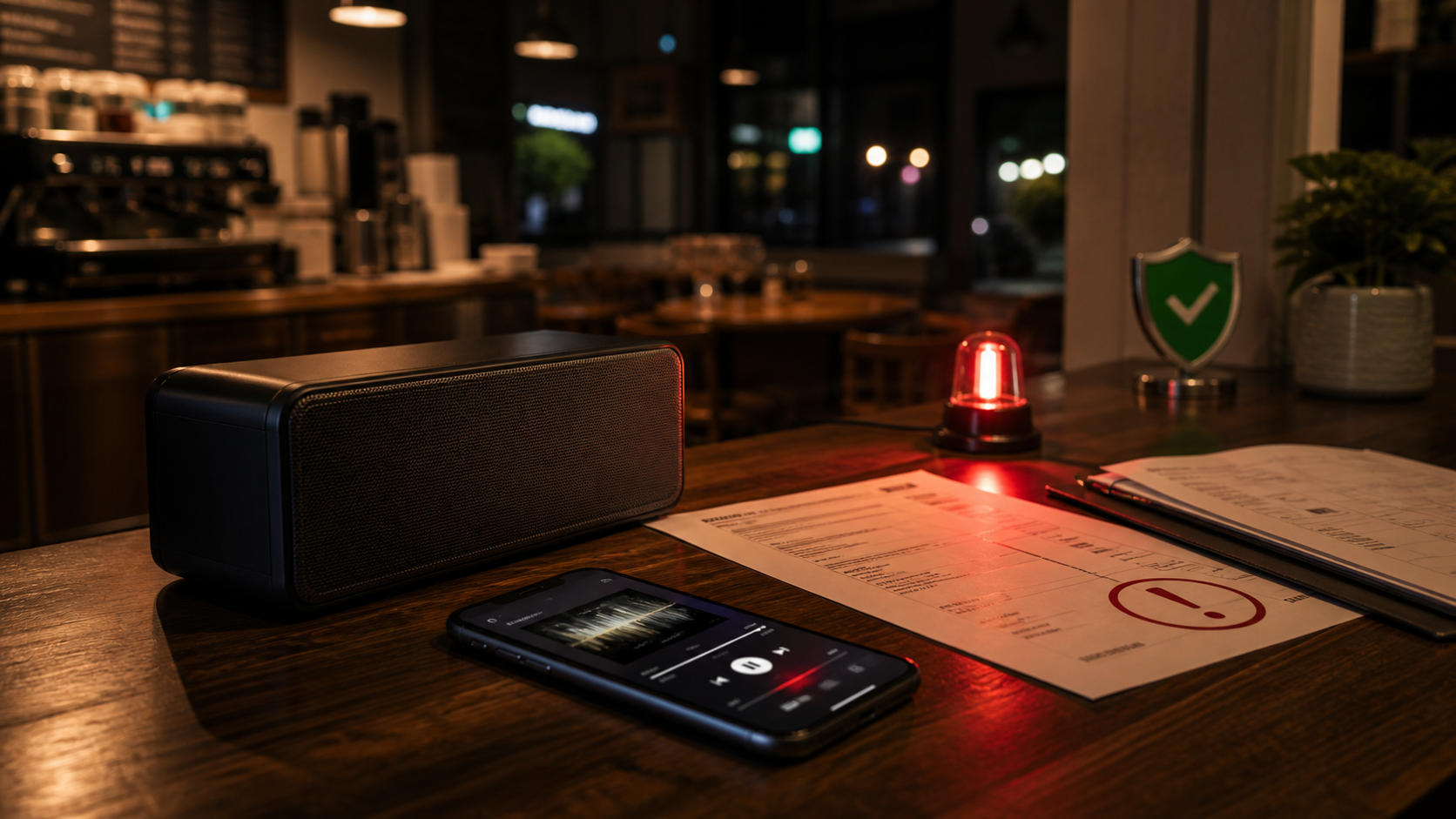
If you pay for the music, why can it still be a problem?
In a small cafe or restaurant, music shapes the mood. A calm playlist can fit the morning. A brighter playlist can fit dinner. Music affects how long guests stay, how the store feels, and even the staff rhythm.
That is why many stores use the most familiar tools.
They open YouTube Premium. They open Apple Music. They play a Spotify playlist.
It feels safe because the store owner already pays every month. There are no ads, the sound quality is good, and the app is stable.
That is exactly why it can be dangerous. It does not feel like free unauthorized use. It feels like "I am paying for this."
But the real question is this:
Did I buy a personal listening subscription, or a right to play music for guests in a business space?
Most personal music subscriptions are closer to the first. The second is a separate rights issue.
The short answer
YouTube Premium, Apple Music, and Spotify Premium are good personal music services. But they are not built as store BGM licenses.
This is why JEMPO treats store background music as an operating issue.
Instead of asking owners to play personal streaming apps with uncertainty, JEMPO should provide royalty-free music designed from the start for store use.
Orders, staff calls, and QR menus organize the store's movement. Store music organizes the atmosphere. That atmosphere should not sit on top of copyright risk.
Personal subscriptions and store playback are different rights
When you subscribe to a music service, you can listen to music. But "can listen" does not mean you can use the music in every place and for every purpose.
Listening alone at home is different from playing music in an open store where guests can hear it.
A store is not a private listening room. Guests come and go, sales happen, and music becomes part of the store experience. This can connect the use to public performance rights.
When reviewing store music, separate three things:
- Platform access: the right to use services like YouTube, Apple Music, or Spotify
- Personal listening: the right for an individual to listen
- Store performance: the right to play music for guests in a commercial space
Personal streaming subscriptions usually cover the first two. They do not automatically include the third.
YouTube Premium is not a store music license
YouTube's terms are relatively clear.
YouTube Terms of Service describe the service and content as being provided for personal, non-commercial use, and restrict uses that YouTube does not permit. The terms also include examples involving public screening and streaming music from the service.
YouTube Paid Service Terms of Service also limit paid services to personal, non-commercial use and restrict public presentation of paid services.
YouTube Premium gives individual conveniences such as ad-free viewing, background playback, and offline saving. It is hard to read it as including the right to play music for customers during business hours.
In short:
YouTube Premium is an ad-free personal listening subscription, not a store background-music performance license.
Apple Music follows the same pattern
Apple Music has a similar structure.
Apple Media Services Terms and Conditions describe services and content as being for personal, noncommercial use. They also state that no commercial or promotional use rights are transferred and that rights of copyright owners are not granted or waived.
For store operations, that matters.
Subscribing to Apple Music does not by itself give a cafe or restaurant the commercial right to play those tracks for guests. Connecting a personal account to store speakers can fall outside the personal, noncommercial scope the service is designed for.
Spotify Premium is also not for store use
Spotify also defines the scope of its personal service.
Spotify Terms of Use grant access to the Spotify service and content for personal, non-commercial use and restrict uses not expressly permitted in the terms.
So paying for Spotify Premium does not create a right to play music to customers in a store.
Spotify is a service for personal listening. For store use, a business-use music service with cleared rights should be reviewed instead.
There are real cases where stores were sued over music
This is not just theory. In the U.S., bars and restaurants have repeatedly faced public-performance-related lawsuits over music played in business spaces.
Pitchfork reported in 2019 that ASCAP filed copyright infringement lawsuits against 13 bars and restaurants across the U.S.. According to the report, one Baltimore sports bar was accused of playing three ASCAP-member songs without the proper license. The owner reportedly said the business had licensed music through a Pandora business account, but ASCAP raised a separate public-performance issue. Pitchfork also reported that the complaint referred to statutory damages from $750 to $30,000 per work.
Middletown Press reported in 2025 that a Connecticut pizza restaurant was among businesses named in ASCAP-related copyright infringement lawsuits. The article reported ASCAP's claim that it had tried for years to explain licensing, and that the lawsuit sought damages of at least $750 and up to $30,000 plus costs.
These are U.S. cases about U.S. law and ASCAP licensing. The same amounts or procedures should not be assumed for Korean stores.
But the operating lesson is clear.
Store music is not "just background sound." It can become a real dispute and cost issue.
The issue is not whether you paid
Many owners think:
"I am not listening for free. I pay every month. Why is it a problem?"
But for copyright and platform terms, the important point is not only whether money was paid. It is what the payment was for.
A personal subscription fee pays for personal use. Store playback is a different use. The same track has a different rights structure when heard privately at home versus by customers in a business space.
It is similar to other media. Buying a movie on a personal account does not mean you can show it on a cafe wall. Buying an ebook does not mean you can copy it for customers. Music works the same way.
Subscription is not ownership. Subscription is permission to access and use content within a defined scope.
Korean copyright law raises a performance-rights question
Under Korean copyright law, store music can connect to performance rights.
Article 29 of the Korean Copyright Act provides exceptions for certain non-profit performances and broadcasts. Article 29(2) allows playing commercial phonograms to the public when no admission fee is charged for that performance.
But there is an important condition.
Cases prescribed by Presidential Decree are excluded.
That decree is Article 11 of the Enforcement Decree of the Copyright Act. It lists business types and facilities where the exception does not apply in the same way for performances using commercially published phonograms.
Examples include:
- Coffee shops
- Other non-alcoholic beverage shops
- Draft-beer pubs
- Other drinking establishments
- Entertainment bars
- Businesses where music or video appreciation equipment is part of the business
- Certain sports facilities
- Hotels, casinos, theme parks
- Large retail stores
So playing music for guests in a store is not simply a matter of turning on a personal app. Depending on the business type and usage, public performance rights need to be reviewed.
This does not mean every store has the same risk
This part needs care.
Not every act of playing music in a store can be judged the same way. The answer can depend on business type, space, playback method, payment relationship, rights-management coverage, and the relevant exceptions under the Enforcement Decree.
But personal streaming services need to be reviewed separately.
Even when performance-right analysis is complicated, personal platforms like YouTube, Apple Music, and Spotify generally assume personal, non-commercial use. Store playback therefore carries a significant terms-of-service risk.
In short:
- Copyright performance-right issue: depends on business type and use
- Platform terms issue: personal subscriptions are risky for store playback
- Practical risk: rights holders, platforms, collecting societies, complaints, and contract breaches can overlap
"We are a small store" is not a safety standard
Even a small cafe or one-person restaurant is not a private listening space if guests come in and business is being done. A small floor area does not turn a personal subscription into a business-use license.
Actual royalty rules and management practices can vary by rights organization, business type, floor area, and usage. But from the owner's point of view, the key question should not be "Will I get caught?"
The better standard is to avoid building operations on an uncertain setup from the start.
Store operations are made of small risks that accumulate. Music may feel minor, but if the goal is to build a brand and operate for a long time, it is better to use tools with clear rights.
What stores need is royalty-free music designed for business use
The answer is not to use a personal account more quietly.
The answer is to use music made for stores from the start.
Royalty-free music here does not mean "use any music for free." It means music with usage rights organized for store playback, repeat play, and the defined conditions of the service.
Owners should not have to interpret the entire music-rights industry every day.
They need simpler answers:
- Can this music be played in our store?
- Can it be played in a space where guests hear it?
- Can we explain the rights if a question comes later?
- Are we relying on a personal account or personal platform terms?
JEMPO store background music should start from that standard.
The key is to provide royalty-free music designed for store use, so owners do not need to turn on uncertain personal streaming apps.
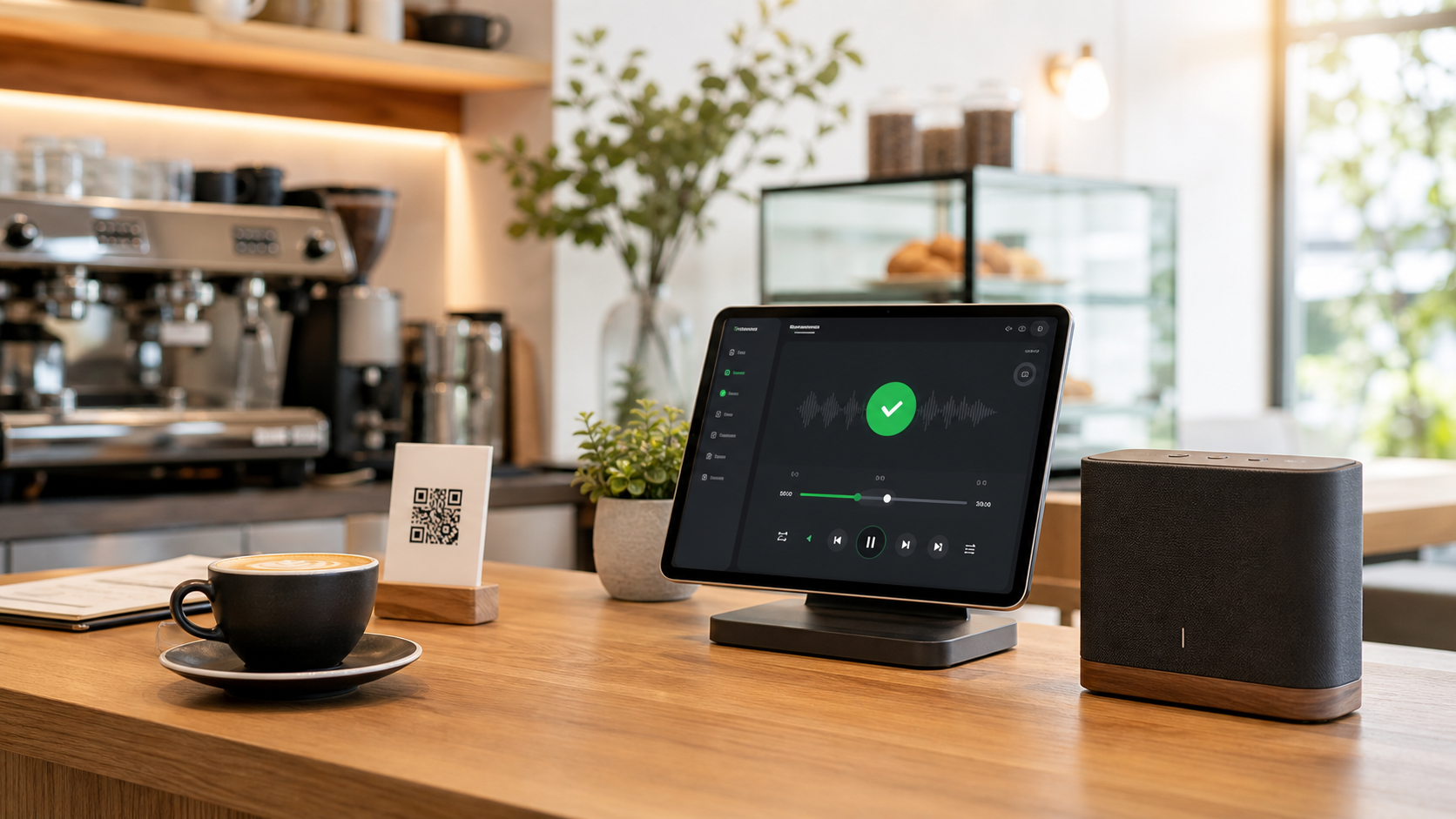
What to check before choosing store music
Do not choose store music only by app name or monthly price.
Check these questions:
- Is the service for personal use or business use?
- Do the terms allow commercial or store use?
- Does it cover playback to guests in a store?
- Are related rights such as sound recordings and performances handled, not only musical compositions?
- Can the rights be used in Korea?
- Are extra fees or separate contracts required by business type, floor area, or number of stores?
- Can the store show proof of rights if a problem arises?
A good store music service is not just a service with many playlists. It has to explain why the music can be played in a store.
JEMPO's standard for store music
JEMPO does not see store operations as only orders and staff calls.
Table QR, staff calls, menus, the owner app, and store atmosphere are connected. A guest enters, sits, reads the menu, orders, waits, and stays. Music is part of that experience.
But store music should not end with "connect any app and press play."
Owners need more than a convenient play button. They need an operating tool that is cleared for store use.
If JEMPO provides background music, the standard should be clear:
- Do not package personal streaming account playback as a store feature.
- Provide royalty-free music that can be used in stores.
- Clearly explain where and how the music can be used.
- Consider copyright differences by country and business type.
- Help owners avoid unnecessary risk later.
Music can improve a store. Music with unclear rights can become an operating risk.
JEMPO's answer is not "use our app instead of YouTube Premium and play anything."
JEMPO's answer is: use music made for stores from the start.
Conclusion: use store music, not personal music apps
YouTube Premium, Apple Music, and Spotify Premium are excellent personal music services. But a service that is good for personal listening is not automatically a service that can be played to guests in a store.
The key is not whether you paid for the subscription. The key is what that subscription allows.
For store music, the safer principle is:
Personal music apps are for personal listening. Store music needs store-use rights.
If JEMPO provides store background music, it should not avoid this principle.
Royalty-free music that can be used in stores from the start. Music that owners do not need to legally interpret every day. Music organized inside operations, just like ordering and staff calls.
Owners already have enough to manage: orders, calls, menus, tables, staff movement, and customer service. Music should not be another uncertain risk.
A good store operating tool should be convenient. But before it is convenient, it has to be usable in the right way.
References
- YouTube Terms of Service. Referenced for personal, non-commercial use and restrictions on public screening and music streaming.
- YouTube Paid Service Terms of Service. Referenced for personal, non-commercial use and public presentation restrictions.
- Apple Media Services Terms and Conditions. Referenced for personal, noncommercial use and lack of commercial/promotional rights transfer.
- Spotify Terms of Use. Referenced for personal, non-commercial access and use of Spotify service and content.
- Korean Copyright Act, Article 29. Referenced for non-profit performance/broadcast and commercial phonogram playback provisions.
- Enforcement Decree of the Korean Copyright Act, Article 11. Referenced for business types and facilities excluded from the commercial-phonogram performance exception.
- Pitchfork, "ASCAP Hit Multiple U.S. Bars With Copyright Lawsuits," 2019. Referenced for U.S. bar and restaurant copyright infringement lawsuit reporting.
- Middletown Press, "Middletown restaurant among 15 across U.S. being sued for alleged copyright infringement," 2025. Referenced for ASCAP-related restaurant copyright lawsuit reporting.